Build, Buy, Configure or Integrate? A Realistic Framework for Your 2027 Technology Investments
The IT budget dilemma for the new year
As senior management and technology leaders plan their strategic roadmap and budgets for 2027, the demand for a clear business return on every investment is stronger than ever.
For years, the discussion around technology decisions was trapped in a simplistic dilemma: “an off-the-shelf subscription application (SaaS) or custom software development?” In today’s business reality, that framing falls short. No business can build everything from scratch, but equally, none can secure a competitive edge by relying solely on standardised commercial solutions.
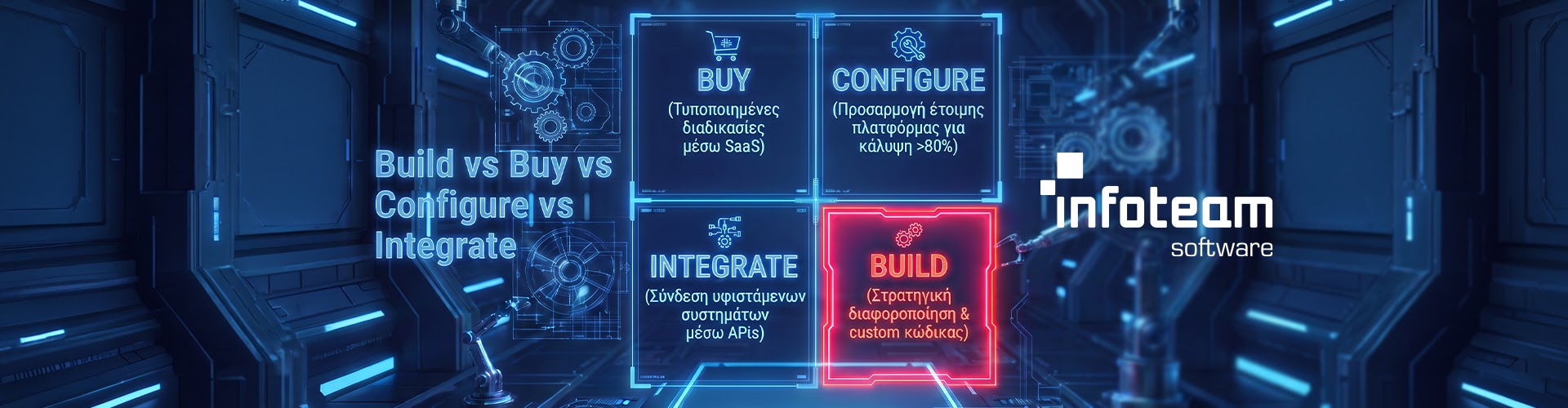
An organisation’s real maturity is not judged by adopting the latest technology tool, but by its leadership’s ability to assess its functions and allocate them rationally across four distinct directions: Buy, Configure, Integrate or Build.
1. Buying off-the-shelf software (Buy)
Purchasing a ready-made subscription platform is the most sensible move when a process is standardised and the market already offers mature solutions.
- When it is the best choice: for support functions that don’t differentiate the business from its competitors, such as basic payroll, internal support ticket management or corporate communication.
- The benefits: very fast go-live, predictable upfront cost, and maintenance, upgrades and infrastructure security handed over to the provider.
- The limitations: little control over the platform’s future direction, the risk of data lock-in, and operating costs that keep rising as the number of users grows.
2. Configuring an existing platform (Configure)
When an organisation already has a strong business system (such as a central resource planning or customer relationship management system), adapting its existing capabilities to the company’s needs is often the most efficient route.
- When it is the best choice: when the system’s core functions cover more than 80% of the requirements of the daily workflow.
- The benefits: making use of proven business patterns without writing code from scratch, while keeping a single user base.
- The limitations: the over-customisation trap. When a business tries to force an off-the-shelf platform to work in a way that goes against its original design, it piles up technical complexity, makes future upgrades prohibitively difficult and inflates support costs.
3. Integrating systems (Integrate)
In many cases, a business’s problem is not that its applications are inadequate, but that they don’t communicate with each other.
- When it is the best choice: when existing departments (production, warehouse, accounting, sales) use specialised tools that work reliably on their own, but staff are forced to move data manually through spreadsheets and repeated data entry.
- The benefits: protecting the capital already invested, avoiding a risky and costly replacement of the core system, and eliminating isolated islands of information through modern APIs and an intermediate integration layer.
- The limitations: it requires a disciplined data architecture and strictly defined touchpoints. Otherwise, there is a risk of creating a labyrinthine, uncontrolled web of point-to-point connections that makes maintenance extremely difficult and error-prone.
4. Developing custom software (Build)
Building proprietary code is not just a technical choice, but a strategic capital investment.
- When it is the best choice: only when the process being developed is the core of the organisation’s commercial differentiation, when off-the-shelf solutions impose suffocating constraints on the business model, or when full control of data and intellectual property is fundamental.
- The benefits: full technological autonomy, complete adaptation to the organisation’s particularities, no recurring per-licence fees, and software recorded on the balance sheet as a high-value intangible asset.
- The limitations: it requires an initial investment budget, strict project governance during delivery and a long-term commitment to its technical support and evolution.
Four critical questions before every investment decision
Before committing resources for 2027, technical and financial leadership should ask four fundamental questions:
1. Does this function create a real competitive advantage?
If the process is standard and similar to your competitors’, buying or simple configuration is the more sensible financial choice. But if it is the reason your customers choose you, it is worth investing in owning it.
2. What is the real total cost over three or five years?
A cheap initial subscription can prove extremely costly over time because of escalating per-user fees and the indirect operational losses from makeshift workarounds. Conversely, the upfront cost of a proprietary system often pays for itself faster in high-activity environments.
3. Do the existing systems work well enough?
The first impulse is often to replace an older infrastructure entirely. In reality, a modern integration layer can recover the value of existing tools, modernising the flow of data at a much lower cost and without business disruption.
4. How exposed is the organisation if strategy changes?
If the provider of an external service unilaterally changes its pricing or drops a critical feature, how easily can the business adapt without putting its business continuity at risk?
The rational strategy: synthesis and realism
The most efficient technology architectures are hybrid. A modern, mature organisation chooses to buy a reliable off-the-shelf application for HR needs, configure its central accounting system, integrate production line data through automated interfaces, and invest in proprietary code for the platform that manages its sales network.
The real value of a strategic technology partner does not lie in the volume of code it writes, but in its ability to guide management objectively, preventing costly and unnecessary investments.
Planning your 2027 technology roadmap
Allocating the IT budget correctly is not about how much money will be spent, but about whether every euro goes where it creates real business value.
If you are planning next year’s technology projects and weighing the operational dilemmas between off-the-shelf solutions, integrating existing infrastructure or building new capabilities, the team of engineers and consultants at infoteam HELLAS MIKE can assess the technical facts with you and compare the available architectural options before you finalise your decisions.