
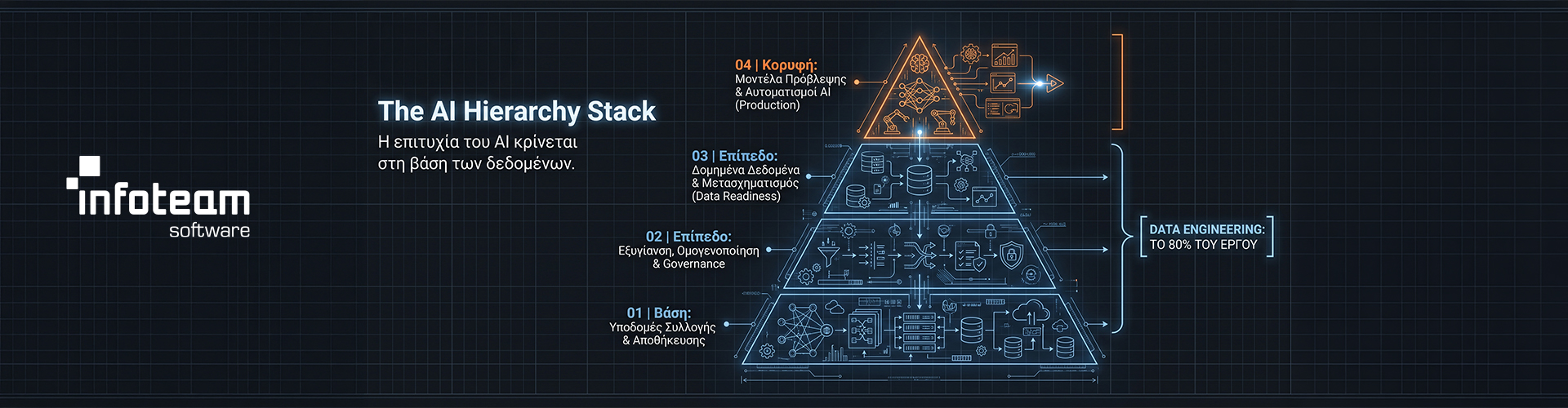
Data Readiness: The Solid Foundation of Artificial Intelligence Projects
Did you know that most Artificial Intelligence pilot projects and proofs-of-concept are abandoned before they ever reach a real production environment? In most cases, the cause is not inadequate algorithms, but the state of the underlying data infrastructure.
Artificial Intelligence does not work on its own, nor can it fix a flawed information architecture. If it is fed incomplete, fragmented or unverified data, the results AI produces will inevitably be unreliable. Before choosing any forecasting model or automation agent, the real technical challenge is first and foremost data engineering.
1. Data integrity and quality
In most business environments, critical information remains scattered across different ERP and CRM systems and older applications. Each system usually follows its own data schema, leading to duplicate records, conflicting values and no Single Version of Truth.
For AI to run reliable analyses without deviations, an intermediate Validation & Cleaning Layer needs to be designed. This layer takes care of cleansing, standardising and harmonising the data before it is fed into the model.
2. Latency and data flow
A common architectural mistake is trying to support dynamic operations with static, manual data exports (such as periodic CSV files at the end of the day).
In processes that require dynamic demand forecasting or immediate adjustment of decisions, data that is even 24 hours old makes AI operationally ineffective. Moving to production use requires stable data pipelines and automated APIs that ensure low latency and a continuous flow of information.
3. Security, governance and tiered access
When a system connects directly to the organisation’s databases, controlling retrieval permissions is fundamental.
Without strict Role-Based Access Control protocols, AI may expose sensitive financial information or personal data to users without the relevant authorisation. The data architecture must build in Zero Trust principles, defining with absolute precision which data may be exposed at each level of inference.
The rational approach: infrastructure review, choosing the solution and gradual implementation
Not every business need requires complex machine learning models. In many cases, stable system integration or a simple automation rule delivers more business value at significantly lower risk.
The right methodology always starts with an architectural assessment of the existing systems (Data Readiness Audit). At infoteam HELLAS MIKE we thoroughly assess the quality, structure and availability of the data, recording the technical bottlenecks. We then put together a clear action roadmap, realistically presenting the technical trade-offs, the infrastructure required and the estimated cost.
These proposals are then discussed in depth with IT management. Only after joint agreement on the architectural parameters, security protocols and performance indicators do we proceed with the gradual, controlled implementation of the data pipelines and the necessary integrations.
The business value AI can deliver is not decided by the algorithm, but by the discipline of the data infrastructure that comes before it. If you are planning projects where AI will support critical processes, the three checks above are a reliable framework for an internal assessment. The infoteam HELLAS MIKE engineering team is available to review the architectural readiness of your systems and compare the best technical options.