
How to reduce the risk when upgrading your software
From weekend anxiety to a safe everyday routine
In many organisations, announcing a new software release still comes with a great deal of anxiety: scheduled out-of-hours downtime, technical teams on standby at weekends and the constant fear that an unexpected bug in production will disrupt business continuity.
This uncertainty is not limited to custom applications. Every technology choice has its own weak spots during an upgrade:
- Off-the-shelf software (Buy / SaaS): unannounced changes to the interface and features removed by the provider catch users off guard, while unexpected changes to external APIs can disconnect critical internal applications.
- Configured platforms (Configure): upgrading the base version of a central system (ERP or CRM) often threatens to break the custom rules, automated workflows and add-ons developed for the company, forcing days of costly manual testing.
- Integrated systems (Integrate): a small, incompatible change to the data structure of an interface (a breaking change) can silently cut communication between the warehouse, production and sales, creating silent data discrepancies.
- Custom development (Build): failures during database updates, configuration differences between the test environment and production, and manual interventions with no way to roll back immediately turn a release into a high-risk process.
The idea that every technical change must inevitably come with business disruption is outdated. In the vast majority of cases, the problem is not the technology itself, but the lack of disciplined release processes (Release Engineering) and modern automation.
For a CTO or IT Director, the goal is not to promise a theoretical “zero downtime” – which ignores the real complexity of distributed systems – but to minimise downtime and limit failures through proven software engineering practices (Release Engineering) and DevOps.
Why do traditional upgrades fail?
The causes that turn a simple update into a business problem are usually specific:
- Manual deployments: when moving code, configuring servers or running commands is done by hand, the human factor makes the process vulnerable to mistakes that are hard to spot immediately.
- Configuration drift: the familiar situation where a feature “works fine in the test environment but fails in production”. Differences in library, database or security configuration versions create unpredictable instability.
- No immediate rollback plan: when something goes wrong, the team is often forced to try to fix the bug directly on the live system (a hotfix under pressure) instead of returning immediately and safely to the previous stable state.
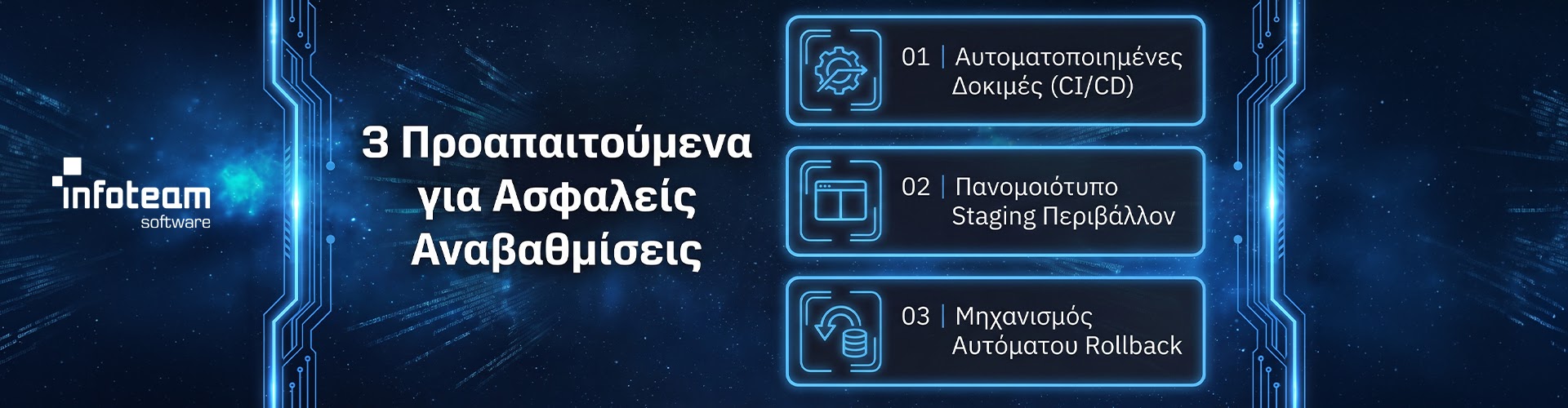
The 3 prerequisites for safe upgrades
Moving to a low-risk model rests on three fundamental technical pillars:
1. Automated testing and delivery pipelines (CI/CD Pipelines)
Manual verification is not enough for modern, complex systems. Through continuous integration and delivery pipelines (Continuous Integration / Continuous Delivery), every code change automatically passes through successive levels of checks:
- Automated unit and integration tests: they catch functional bugs at the moment they are written.
- Static code analysis and security checks: they ensure no vulnerabilities are introduced before the code even reaches deployment.
- A standardised release process: code is packaged and distributed in a fully predictable, automated way.
2. An identical test environment (Staging Parity)
For pre-release testing to be truly valuable, the intermediate test environment (Staging) must be a faithful copy of production.
- Infrastructure as Code (IaC): the configuration of servers, networks and parameters is defined in code files, so there are no differences between environments.
- Realistic test data: tests run on anonymised datasets of a volume comparable to the real one, revealing potential performance problems before they affect end users.
3. Automatic rollback and gradual rollout
The defining feature of a mature system is not the illusion that there will never be a bug, but the speed and safety with which it recovers from one.
- Gradual rollout strategies (Blue-Green or Canary Deployments): the new version runs alongside the old one, or initially receives only a tiny share of the traffic (e.g. 5%). If any anomaly is detected, traffic automatically returns to the previous stable version without downtime.
- Automatic rollback: the mechanism for returning to the previous version is predefined and tested, taking a few seconds instead of hours of manual intervention.
The critical point: managing databases
In most cases of extended downtime, the problem lies not in the application, but in changes to the database structure (Database Migrations).
A safe architecture requires database changes to be designed with backward compatibility. This is achieved by separating the release of the new structure from the release of the new code (the Expand and Contract technique):
- Add new fields without deleting the old ones.
- Release the code that uses the new fields.
- Remove the obsolete fields only once the new version is fully stable.
Operational maturity: how is risk measured?
For technical leadership, the success of a Release Engineering strategy is reflected in measurable indicators:
Upgrade frequency
- Traditional model: every few months (large batches of changes, high risk)
- Modern DevOps practice: on a regular basis (small, controlled changes)
Downtime
- Traditional model: scheduled outages of several hours outside business hours
- Modern DevOps practice: minimised or avoided downtime
Rollback
- Traditional model: a manual process under time pressure
- Modern DevOps practice: an automated process in seconds
Bug detection
- Traditional model: by end users in production
- Modern DevOps practice: in automated testing stages
Building stability into your digital infrastructure
Reducing the risk of software upgrades is not a theoretical goal, nor does it require huge investments in tools. It requires clear architectural design, automation of repetitive steps and discipline in testing processes.
At infoteam HELLAS MIKE, we design and implement CI/CD pipelines and software release architectures that allow organisations to evolve their systems quickly, while safeguarding business continuity and the reliability of their data.